The Brain Is Lazier Than It Seems: 5 Facts About How People (Fail to) Retain Information
24 August 2026
Introduction
The modern digital space creates an illusion that any knowledge is readily accessible. Open lectures from top universities, intensive professional courses, hundreds of saved browser bookmarks, and gigabytes of downloaded materials—all of this fosters a sense of continuous self-development. However, the completion statistics for educational programs are unforgiving: the lion's share of purchased courses is never finished, and only a tiny fraction of the read material actually remains in memory. A logical question arises: why, despite having the best tools at our disposal, is the absorption of information so inefficient?
The answer lies not in a lack of willpower, discipline, or motivation. The main "saboteur" of the learning process is the brain itself. What is typically called mundane laziness in everyday life is actually a flawless evolutionary mechanism for energy conservation.
The brain is wired to optimize all internal processes and avoid unnecessary strain wherever possible. Therefore, effective self-education cannot rely on enthusiasm alone. For learning to yield real results, it is essential to understand how memory works on a neurobiological level. Below are five scientifically grounded facts about the cognitive traps that hinder learning, along with ways to bypass this natural "laziness."
5 Scientific Facts
Fact 1: The "Cognitive Miser" Concept
From an evolutionary perspective, the human brain is an incredibly "expensive" organ. While accounting for only about 2% of an adult's total body weight, it consumes roughly 20% of the body's available energy at rest. Due to this high metabolic cost, nature has developed a defense mechanism: the brain tries to minimize cognitive effort whenever possible.
In 1984, psychologists Susan Fiske and Shelley Taylor introduced the term "cognitive miser" to the scientific community. According to this concept, humans are evolutionarily predisposed to seek the simplest and least energy-consuming ways to process information, relying on mental shortcuts rather than deep analysis.
Nobel laureate Daniel Kahneman described this resource allocation mechanism most thoroughly. He identified two competing systems of thinking:
-
System 1: fast, automatic, and emotional. It operates continuously in the background, requires almost no effort, and is responsible for instinctive reactions.
-
System 2: slow, logical, and conscious. It demands significant energy expenditure and is activated only during complex calculations, non-standard problem-solving, or focused learning.
Since the quality absorption of new information absolutely requires the engagement of System 2, the brain often "sabotages" this process, trying to substitute a complex task with a simpler one and switch back to System 1. This is exactly why, instead of concentrating on a difficult concept, attention automatically shifts to familiar or entertaining stimuli—it simply requires less energy.
|
Characteristic |
System 1 (Automatic) |
System 2 (Analytical) |
|
Reaction Speed |
Instant |
Slow |
|
Energy Consumption |
Minimal |
High (quickly depletes) |
|
Core Processes |
Pattern recognition, instincts, stereotypes |
Focus, self-control, learning something new, logic |
|
Role in Learning |
Creates an "illusion of knowledge," relies on the already known |
Responsible for deep understanding and forming new neural pathways |
Fact 2: The Illusion of Competence, or Why Rereading Material Doesn't Work
One of the most popular approaches to learning is repeatedly rereading notes, highlighting text, and rewatching lectures. However, cognitive psychology proves that these methods are the least effective. They create a dangerous phenomenon known as the "illusion of competence."
When a person rereads a familiar text, the brain processes it much faster and more easily than during the first encounter. This cognitive fluency sends a false signal to the brain: "It's easy for me to read this, therefore I know it." In reality, what happens is mere recognition of information, not true absorption. The brain sees familiar words but does not form the strong neural pathways needed to independently retrieve this information from memory in the future.
True learning occurs only through effort—when the brain is forced to pull information from memory without cues. This process is called "active recall" or retrieval practice. Studies show that testing your own knowledge (even if you make mistakes) creates much stronger memory traces than passive absorption of the exact same material. The difficulties that arise when trying to recall material signal to the brain the importance of this information, stimulating its consolidation.
Fact 3: The Ebbinghaus Forgetting Curve, or Why the Brain Deletes 70% of Data in a Day
Even if information has been successfully processed by System 2 and initially absorbed, this does not guarantee its retention. The brain acts as a strictly ruthless memory manager: anything that is not used regularly is labeled as "unnecessary information" and mercilessly deleted. This process is known in neurobiology as synaptic pruning—the weakening and elimination of rarely activated neural connections.
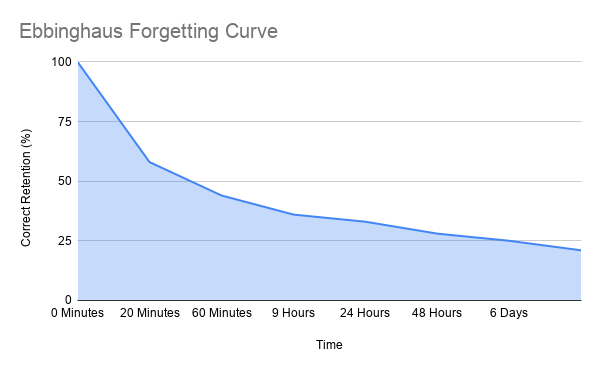
This mechanism was first mathematically described by the German psychologist Hermann Ebbinghaus back in 1885. Through a series of experiments memorizing nonsense syllables, he constructed what is known as the "forgetting curve." The results were striking: without repetition, a person loses about 40% of newly acquired information within the first 20 minutes, and after 24 hours, no more than 30-33% of the learned material remains in memory.
From the perspective of evolution and energy conservation, this is an absolutely logical step. Every day, the brain encounters terabytes of sensory data. If it kept every detail forever, the body's resources would quickly run out. Therefore, transferring information from short-term to long-term memory requires a clear signal of importance.
The most effective such signal is "spaced repetition." The essence lies in recalling the material at the exact moment the brain is just starting to forget it. Every such reminder not only restores the knowledge level to 100% but also changes the angle of the forgetting curve—the next time, the information will fade much more slowly.
Fact 4: The Myth of Multitasking
Modern productivity culture often idealizes multitasking. The ability to simultaneously listen to an educational webinar, skim through work chats, and scroll a news feed seems like a sign of efficiency. However, neurobiology is categorical: in the context of complex cognitive processes, multitasking does not exist. What subjectively feels like doing things in parallel is actually rapid attention switching (task-switching).
Each such switch is accompanied by additional physiological costs. The prefrontal cortex, which is responsible for focus and analysis, is forced every time to interrupt the current cognitive process, clear working memory of previous information, and fully tune into the specifics of the new task. Such abrupt shifts in attention significantly increase glucose consumption by nerve cells. As a result, instead of effectively absorbing information, rapid cognitive exhaustion sets in.
Another hidden threat was revealed by Professor Sophie Leroy, who described the phenomenon of "attention residue." According to her research, when a person interrupts reading a complex article to answer a quick message, a part of their cognitive resources remains "tied" to that correspondence. Returning to the text, the brain is unable to immediately restore 100% concentration. The more often these micro-interruptions occur, the more superficial the understanding of the material becomes, and the new information simply fails to reach long-term memory.
Fact 5: The Dopamine System and the Problem of Delayed Gratification
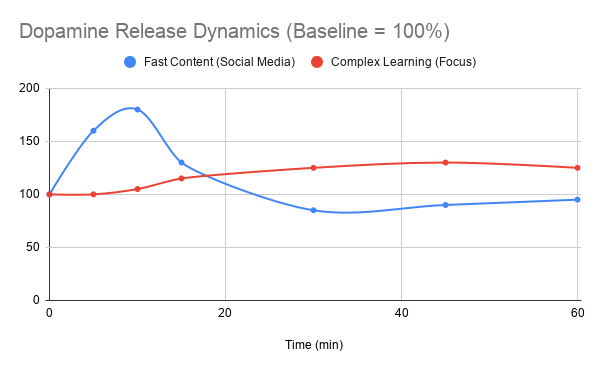
The learning process is inextricably linked with the neurotransmitter dopamine, which is responsible for motivation and the anticipation of a reward. Evolutionarily, the dopamine system was formed to encourage actions that yield an immediate physiological result. The modern digital environment exploits this mechanism by offering high-dopamine-release stimuli that require minimal cognitive effort.
Watching short videos, scrolling through news feeds, or getting reactions on social media triggers rapid and intense spikes in dopamine. In contrast, learning a new, complex topic is a process involving delayed gratification. The outcome of self-education, such as professional upskilling or forming a new habit, only becomes noticeable and brings satisfaction after a considerable period of time.
Since the brain evolutionarily strives to minimize energy expenditure, it naturally prefers activities that provide the fastest release of neurotransmitters with the least amount of effort. When faced with a choice between studying professional literature and consuming entertaining content, the dopamine system pushes for the latter. To successfully absorb information, one must consciously lower their stimulation levels before beginning to study. The absence of easy dopamine sources allows the nervous system to maintain an adequate level of motivation for tackling complex cognitive tasks with delayed outcomes.
How to Overcome Cognitive Resistance and Optimize Learning
Understanding the brain's physiological limits is a fundamental prerequisite for effective self-education. Given the high energy cost of cognitive processes, the speed of forgetting, and the influence of the dopamine system, the process of absorbing new information requires clear structuring.
To optimize learning and transfer information into long-term memory, the following practices must be implemented:
-
Implement spaced repetition. Return to the studied material after 24 hours, then in a week, and in a month to alter the forgetting curve.
-
Practice active recall. Instead of passively rereading text, generate answers from memory by testing yourself or writing notes without looking at the source.
-
Commit to single-tasking. Dedicate specific blocks of time exclusively for learning, completely isolating yourself from work chats, social media, and other triggers that cause attention switching.
-
Minimize high-dopamine stimuli. Abstain from consuming short, entertaining content right before and during the educational process to preserve your capacity for sustained concentration.
For the successful application of the described methods, a high-quality source of knowledge is required. The educational web service Learn2Go provides access to expert online courses and recorded webinars. This asynchronous learning format allows you to independently plan your schedule, manage cognitive load, and pause videos to take notes or practice active recall. The platform ensures convenient access to structured material, allowing you to organize the educational process at a comfortable pace without unnecessary pressure.